
On this page
- When does a tree at a Forney house need to come down?
- Does the kind of property change what Forney requires?
- What if the tree is dead or could fall on someone?
- Who answers for it if your tree falls?
- What changes when the tree is near power lines?
- Does the stump work need an 811 call?
- What happens on removal day?
- Where does all the wood go afterward?
- How much should a removal cost?
- Other questions about removing a tree in Forney
When does a tree at a Forney house need to come down?
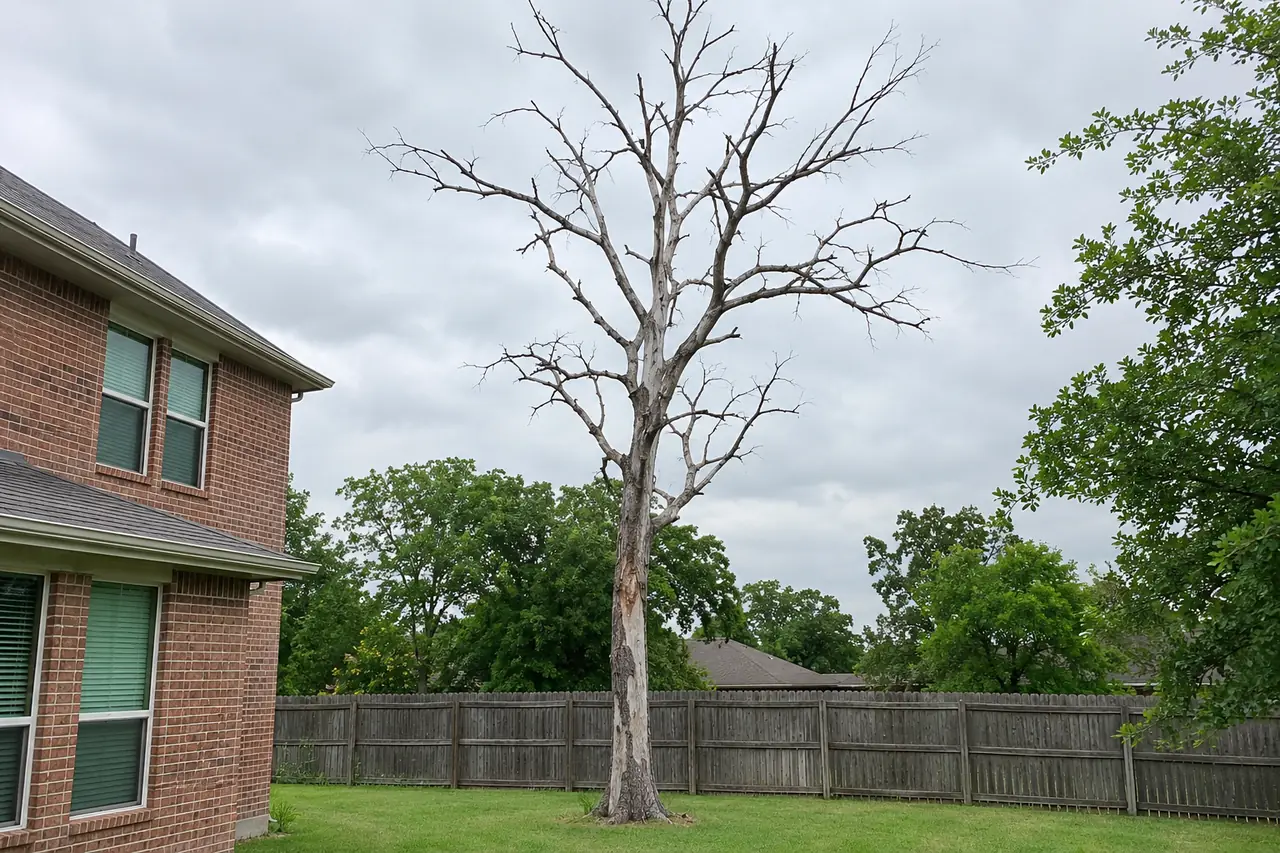
The common reasons to take a tree down are easy to list. A tree has died, or half of it has. A storm split the trunk or tore off the main limbs. Bark is falling off an oak in patches. A tree planted too close to the house is now over the roof. Or an ash tree in the yard has people wondering what emerald ash borer will do when it arrives.
The Texas A&M Forest Service is blunt about the first case: "Standing, dead trees are dangerous and unpredictable," and on a dead tree near a home, road or path its advice is to "Remove the tree, which removes the risk" (checked Nov 14, 2026). For storm damage, the same agency says a tree with a split trunk, or one missing more than half its leaves, probably won't survive. Each of those situations has its own page here: dead and dying trees, storm damage and ash trees.
Does the kind of property change what Forney requires?
Yes, and it's the first thing to settle. Section 39a lists the land it applies to in 39a.2.A, then carves out exceptions in 39a.2.B. Here is how that sorts out, read from the city's 2026 PDF (checked Nov 14, 2026):
| Where the tree stands | Under Sec. 39a? | What that means for removal |
|---|---|---|
| Developed lot zoned single-family, with an existing house | No (39a.2.B.3) | No city tree removal permit |
| Vacant or undeveloped land | Yes (39a.2.A.1) | Protected trees need city approval (a Tree Removal Permit, or with the site plan if building) |
| Property being redeveloped, including additions and major renovations | Yes, except single-family property (39a.2.A.2) | Tree removal reviewed with the site plan, plat or building plans |
| Required yard and landscape areas of other developed property | Yes, except single-family property (39a.2.A.3) | City approval for protected trees |
| City rights-of-way, streets, public easements and parks | No; the Forney Code of Ordinances governs them (39a.2.B.1) | Ask the city; not a homeowner decision |
| Utility work to provide, extend or maintain service | Exempt (39a.2.B.2) | The utility's own call |
A "protected tree," in the ordinance's words, is any tree named in the city's Section 50 Approved Plant List that is at least six inches in caliper. That list wasn't part of what this site read, so on covered land, treat any good-sized tree as possibly protected until the city says otherwise.
The ordinance isn't the only paper that can matter. A subdivision plat or HOA rules can carry their own tree or landscaping conditions, so check those before cutting. If you're not sure how your lot is zoned, the City of Forney Community Development office is at (972) 552-6549 (number from the Forney EDC's development page, checked Nov 14, 2026).
What if the tree is dead or could fall on someone?
On land that Section 39a does cover, the ordinance itself sets the standard: "In all instances, removal of a protected tree shall be approved" when the tree is a hazard to life or property that can't reasonably be fixed without taking it down, when it is dead, dying or diseased past the point of restoring it, or when its disease can be expected to spread to other trees (Forney Zoning Ordinance Sec. 39a, checked Nov 14, 2026).
State law generally backs that up across Texas. Local Government Code §212.905(h) says no city may forbid removing a dead or diseased tree, or one that's an imminent or immediate danger to people or property, and no city may attach a tree mitigation fee to that removal (checked Nov 14, 2026). That law limits bans and fees; it doesn't say a city can never ask for paperwork, so on covered land, expect to show the city why the tree qualifies.
Subsection (b) of the same law adds a second limit: at a one- or two-family house you live in, a city can't charge that fee at all for a tree less than 10 inches thick at 4.5 feet above the ground (checked Nov 14, 2026).
Who answers for it if your tree falls?
You do, as the Texas A&M Forest Service puts it: "if the tree is on your land, you're liable for any loss or damage caused when it falls." Its hazard-tree page adds that failing to deal with dead trees near homes, roads or paths "could make you liable for resulting damage" (checked Nov 14, 2026).
Your homeowners policy is the other half of that. According to the Texas Department of Insurance, a lot of homeowners policies cover what a falling tree breaks, yet a tree or limb that just comes down in the yard usually isn't covered, and when a neighbor's tree hits your house, their policy probably won't pay unless they were at fault (TDI, checked Nov 14, 2026). A dead tree you knew about is the kind of thing worth dealing with before a storm decides for you. More on claims is on the storm page.
What changes when the tree is near power lines?
Almost everything. Under Texas Health and Safety Code §752.004, nobody may do work in which they, or a saw, rope, lift or limb they're handling, might get within six feet of a high-voltage overhead line, unless the hazard has first been dealt with the way §752.003 lays out. That section puts a 48-hour clock on it: whoever is in charge of temporary work closer than six feet tells the line's operator at least two days ahead (checked Nov 14, 2026).
The Texas A&M Forest Service's storm advice is shorter: "DO NOT remove limbs on or near power lines" (checked Nov 14, 2026). If any part of the tree touches or hangs over a line, call the electric company that serves your home before anyone starts cutting, and tell the contractor about the line when you send your request.
Does the stump work need an 811 call?
If the stump is going to be ground out, very likely. Texas Utilities Code §251.002(5) counts using powered equipment to disturb soil 16 inches deep or more as excavating, and §251.151(a) sets the window for the locate request to a notification center (dial 811): at most 14 days ahead of the digging and at least 48 hours ahead, with Saturdays, Sundays and legal holidays left out of the count (checked Nov 14, 2026). The stump grinding page covers the rest, including what to do when lines aren't marked.
What happens on removal day?
No two trees come down the same way, but a removal at a house generally moves through these steps:
- Reading the site. Before any cut, the crew looks at what sits under the crown (roof, fence, patio, a neighbor's yard), where pieces can land, and how equipment gets in. In a fenced backyard, gate width can decide whether a lift or chipper fits.
- Lines first. Anything within reach of an overhead line is sorted out with the electric provider before work starts, because of the six-foot law above.
- Limbs, then trunk. Where there's open lawn in every direction, the whole tree may be felled at once. Over a house or fence, the work usually goes top-down, piece by piece, with heavy sections lowered on rope instead of left to fall.
- Bucket truck or crane where climbing isn't safe. Decay changes how a tree can be worked; the Forest Service warns that a tree infected with hypoxylon canker "may not support the weight of a climber." Bringing in a crane adds $500 to $2,500 a day, by HomeGuide's figures (checked Nov 14, 2026).
- Cutting up and chipping. The trunk is cut into rounds, and the brush goes through a chipper.
- Cleanup and the stump. The stump is either left a few inches high or ground out after the 811 marks are in, and the wood is hauled or left, depending on what you agreed.
Ask about each step when the contractor gives you a price, so you know what's included before the day comes.
Where does all the wood go afterward?
Hauling is often a separate line on the price. HomeGuide puts tree debris removal at $75 to $250 per dump trip, and fallen-tree removal, including hauling and disposal, at $100 to $600 per tree (checked Nov 14, 2026). If you want logs left in rounds for firewood, or the chips left for mulch, say so up front.
Burning the brush yourself is a separate question. Inside Forney city limits, the city code has its own outdoor burning article (Chapter 5, Article 5.05); check with the city before burning anything there (checked Nov 14, 2026). Outside the city, the Kaufman County Commissioners Court can order burn bans under Local Government Code §352.081, and the state's TCEQ rule allows burning household waste from the property, branch trimmings included, where the local government doesn't provide trash collection (checked Nov 14, 2026). The rules page has the details.
How much should a removal cost?
National guides put the average removal at $906 (This Old House, updated Mar. 5, 2026; its summary box says $960) to $1,150 (HomeGuide), with HomeGuide's usual range running $300 to $2,000. Angi puts the average for a large tree at $1,264, and HomeGuide's city table lists Dallas at $320 to $2,100 (all checked Nov 14, 2026). None of those is a Forney price. Height, access, what's under the tree and how the wood leaves all move the number, and the cost page breaks it down by height in tables.
Other questions about removing a tree in Forney
How long does the city take to decide on a permit, where one is needed?
For a Tree Removal Permit (removal with no construction project), the City Manager or a designee has 30 calendar days to approve or deny a removal application, and if no denial comes by the close of business on the 31st day, the code treats the application as granted. Once a permit is issued, the tree has to come down within 180 days (checked Nov 14, 2026).
Will I have to plant replacement trees?
Not on an exempt single-family lot. On covered land, the ordinance calls for replacement trees worth at least three times the value of the trees removed, capped at one tree per 500 square feet of unpaved site area. The ratio drops to one-to-one only in single- and two-family zoning districts, and only when the loss was an act of God or otherwise beyond the owner's or tenant's control (checked Nov 14, 2026). The full rule is on the Forney rules page.
Can I take down a neighbor's tree that leans over my house?
Not on your own say-so; the tree belongs to whoever owns the land it grows on. Branches that cross the property line are a different matter, covered on the trimming page.
Ready to have someone look at it? Call (469) 689-1811 or use the request form; a single independent contractor serving Forney and the rest of Kaufman County picks it up from there.
Sources: City of Forney Zoning Ordinance 2026-2, Sec. 39a (posted Apr. 9, 2026); Forney EDC, development process; Tex. Local Gov't Code §212.905; Tex. Health & Safety Code §752.004 and §752.003; Tex. Utilities Code ch. 251; Texas A&M Forest Service pages on hazardous trees, storm-damaged trees, cold and ice damage and hypoxylon canker; TDI, fallen trees and insurance and TDI column; Forney Code Art. 5.05; Local Gov't Code §352.081; 30 TAC §111.209; HomeGuide, This Old House, Angi tree service cost. All checked Nov 14, 2026.