
On this page
- What is hypoxylon canker, and why does it worry oak owners?
- Did the 2021 freeze kill your tree, or just set it back?
- How hard has drought hit North Texas trees?
- Could building the house have hurt the tree?
- What else commonly weakens yard trees here?
- Who's responsible if a dead tree falls?
- When does a dead tree have to come down?
What is hypoxylon canker, and why does it worry oak owners?
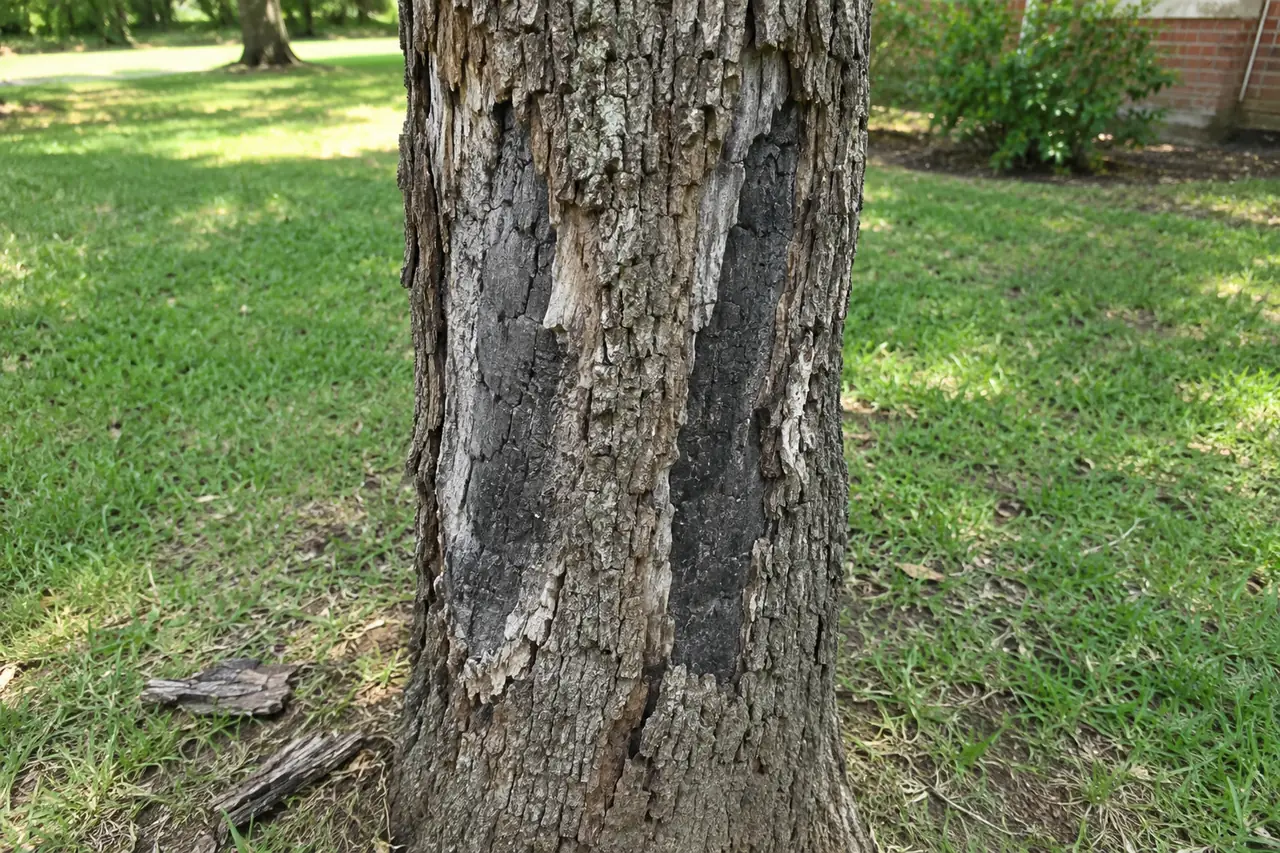
It's a tree disease, and the Forest Service doesn't soften what it does: "Once hypoxylon actively infects a tree, the tree will likely die." All oaks are likely susceptible, and the agency lists elm, pecan, hickory, sycamore, maple and beech among other trees it can infect. It gets worse in dry years: "Hypoxylon canker activity usually increases when prolonged drought occurs" (checked Nov 14, 2026).
Two points from the same page bear directly on removal. An infected tree can be dangerous to climb, because "the tree may not support the weight of a climber," which can mean a bucket truck or crane instead. And dead trees near structures, roads, fences or power lines should come down as soon as possible.
Did the 2021 freeze kill your tree, or just set it back?
Winter Storm Uri in February 2021 put Kaufman County in FEMA's disaster declaration DR-4586 (checked Nov 14, 2026). Afterward, the Forest Service reported that many oaks, live oaks among them, were still bare months later, and its foresters urged patience: "If your tree is dead, there's no rush to take it down." Their test was mid-July; a tree with zero leaves by then is dead (May 4, 2021 release, checked Nov 14, 2026).
The agency's cold and ice page adds that most live oaks, and many other trees in leaf during a hard freeze, may have suffered freeze damage (checked Nov 14, 2026).
How hard has drought hit North Texas trees?
Hard. By the count in a Texas A&M Forest Service survey released Sept. 25, 2012, the 2011 drought left 301 million trees dead across the state's forested land. The North Texas region lost 8.3% of its forest-land trees, and another 5.6 million trees died in towns and cities, counted separately (checked Nov 14, 2026). The release doesn't break the numbers down by county.
The damage doesn't always show right away. "Severe drought has long-term impacts on trees," the Forest Service's drought page says; "In many cases, drought kills the fine feeder roots that trees use to take up water and nutrients." A publication listed on the same page calls the 2022 drought "the worst in Texas since 2011," and its watering advice is to avoid the hottest part of the day, 10 a.m. to 6 p.m., to cut evaporation (checked Nov 14, 2026). A tree that thins out after a dry stretch may be showing the feeder roots it lost.
Could building the house have hurt the tree?
It can, and Forney has seen a lot of building. The city grew from about 23,300 residents in 2020 to about 41,700 in 2025 (Census Bureau, checked Nov 14, 2026), and the Forney EDC counted 352 home starts in fiscal 2024–2025 and 40,145 preliminary or future home lots (checked Nov 14, 2026). If your trees are older than your house, they lived through a construction site.
The Forest Service names three ways construction kills trees: soil compaction, grade changes and cut roots. "Construction equipment and vehicles are a common cause of soil compaction," and "Lowering the grade removes vital roots and nutrient rich topsoil." The decline can be slow: "It may take several years for trees to overcome and adjust to the injury" (checked Nov 14, 2026). Some codes try to prevent it. Terrell's, for one, bars developers from moving or storing equipment inside the drip line of trees being preserved (Zoning Code §34.8, Ord. No. 3138, Sept. 30, 2025; checked Nov 14, 2026).
What else commonly weakens yard trees here?
- Elm leaf beetles. The Forest Service says elms stripped of their leaves year after year "may die or be weakened" to the point that other insects and diseases take hold. See tree trimming.
- Emerald ash borer. Not confirmed in Kaufman County as of June 2026, but present in Rockwall and Dallas counties; an infested ash is likely to die. See the ash page.
- Oak wilt. Confirmed in 76 Texas counties; this site found no confirmation either way for Kaufman County. The Forest Service's prevention advice is no pruning or wounding of oaks from February through June (checked Nov 14, 2026).
- Storm damage. A split trunk, or a crown missing more than half its leaves, means a tree probably won't survive, per the Forest Service. See storm tree removal.
Who's responsible if a dead tree falls?
The landowner. The Forest Service's hazard-tree page says that "if the tree is on your land, you're liable for any loss or damage caused when it falls," and that not dealing with dead trees near homes, roads or paths "could make you liable for resulting damage." Its advice for a standing dead tree: "Remove the tree, which removes the risk" (checked Nov 14, 2026).
Insurance doesn't fill every gap. The Texas Department of Insurance says a tree or limb that falls in your yard without hitting anything usually isn't covered, and when a neighbor's tree hits your house, the neighbor's policy generally pays only if the neighbor was at fault (checked Nov 14, 2026).
When does a dead tree have to come down?
Soon, if it stands within reach of the house, the street, a fence, a path or a line. The two Forest Service messages fit together: a tree that's only bare after a freeze can wait for the mid-July test, but a tree that's truly dead near structures, roads, fences or power lines is one the agency says to remove as soon as possible.
The rules around Kaufman County all leave room for it. In Forney, a built single-family lot needs no permit, and on land the tree section does cover, the ordinance says removing a dead, dying or diseased protected tree "shall be approved" when restoring it isn't practicable. The City of Kaufman's tree rule exempts dead or diseased trees unless they were planted to meet a landscape or mitigation plan (§02.03.072(c)(8)). Terrell's code says nuisance, hazardous, diseased or noxious trees on development sites may be required to come out, without mitigation (§34.8.E). Over all of them sits §212.905(h) (all checked Nov 14, 2026). Details are on the Forney rules page.
For someone to look at a tree you're worried about, call (469) 689-1811 or choose "Dead or dying tree" on the request form. It goes to one independent contractor who works across Kaufman County. The removal guide explains how the job itself goes.
Sources: Texas A&M Forest Service: hypoxylon canker, oaks after the 2021 winter storm, cold and ice damage, 2011 drought survey (Sept. 25, 2012), drought, protecting roots during construction, elm leaf beetle, EAB, oak wilt, can my tree be saved, hazardous trees; FEMA DR-4586; Census Bureau, Texas city population file; Forney EDC demographics; Terrell Zoning Code ch. V; City of Kaufman Subdivision Ordinance; TDI; Forney Zoning Ordinance, Sec. 39a (posted Apr. 9, 2026); Tex. Local Gov't Code §212.905. All checked Nov 14, 2026.