
On this page
- Where is Forney's tree rule written down?
- Which property does Section 39a cover?
- What exactly does the single-family exemption say?
- What counts as a protected tree?
- How does a Tree Removal Permit work, where one is needed?
- What does the storm exception allow?
- When must the city approve removing a dead or hazardous tree?
- How many replacement trees does the city require?
- How does Texas law limit Forney's tree rules?
- How do Terrell, Kaufman and the rural county differ?
- Can you burn the brush from a removal?
- What other state rules apply to tree work?
Where is Forney's tree rule written down?
In the zoning ordinance, not the city code. Forney's Comprehensive Zoning Ordinance is Ordinance No. 1085, as amended, and the edition the city posted on Apr. 9, 2026 ("Zoning Ordinance 2026-2") carries Section 39a, "Tree Preservation," on pages 205 to 211 of the PDF. The separate Code of Ordinances, posted through Ord. No. 26-19 of June 23, 2026, has no chapter or article titled tree preservation, so a search of the city code alone won't find it (both checked Nov 14, 2026).
Section 39a opens broadly. Sec. 39a.1: "In all zoning districts, the preservation and protection of trees shall be required. Removal of protected trees shall be prohibited except in accordance with the procedures outlined herein." The next subsection then narrows where that actually reaches.
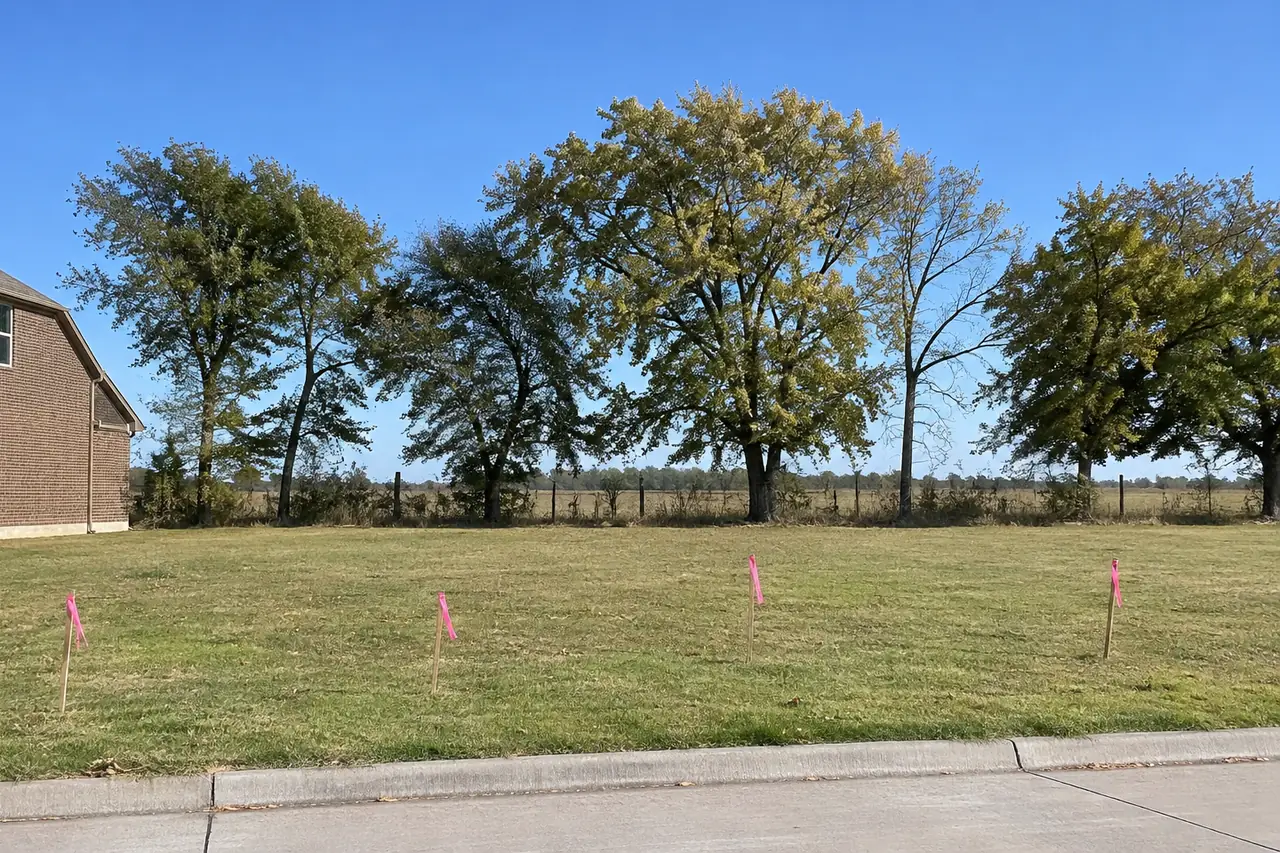
Which property does Section 39a cover?
Sec. 39a.2.A lists three kinds of property (checked Nov 14, 2026):
- All vacant and undeveloped property.
- All property being redeveloped, including additions and major renovations, except single-family residential property as noted in 39a.2.B.3.
- The required yard and/or landscape areas of all developed property, again except single-family residential property under 39a.2.B.3.
Sec. 39a.2.B then sets aside three cases. City property, meaning rights-of-way, streets, public easements and parks, is regulated by the Forney Code of Ordinances instead (B.1). Utilities are exempt while providing, extending and maintaining service (B.2). And built single-family lots are out (B.3).
What exactly does the single-family exemption say?
The full text of Sec. 39a.2.B.3, "Single-Family Residential Property," reads:
"Developed property which is zoned in a single family residential classification and where an existing residence is located shall not be subject to this section."
Three things have to be true: the property is developed, it's zoned in a single-family residential classification, and a house already stands on it. Zoning is the one you can't see from the yard. A lot zoned for two-family homes isn't named in B.3, so a duplex owner should ask before assuming the exemption.
The ordinance isn't the only rule that can reach your trees. A subdivision plat or HOA rules can carry their own tree or landscaping conditions, so read those before cutting. To confirm your zoning, call the City of Forney Community Development office at (972) 552-6549 (number listed by the Forney EDC; checked Nov 14, 2026).
What counts as a protected tree?
Sec. 39a.2.C.1: "Protected tree means any tree named in Section 50 (Approved Plant List) which is at least six inches (6") or greater in caliper size" (checked Nov 14, 2026). The Section 50 list itself wasn't part of what this site read, so it can't say which species are on it. On land the section covers, ask the city before assuming a tree isn't protected.
How does a Tree Removal Permit work, where one is needed?
- When it applies: a Tree Removal Permit is for removing a protected tree when no construction is planned. When the removal is part of a project that needs site plan, plat or building plan review, the tree request is processed with that review instead (Sec. 39a.3.A.1).
- Who decides: the City Manager or a designee.
- How long it takes: the application is approved or denied within 30 calendar days. If it hasn't been denied by the close of business on the 31st day, the ordinance says it "shall be deemed automatically granted."
- How long the permit lasts: trees covered by an issued permit "must be removed within 180 days of the issuance of the permit."
All from Sec. 39a, 2026 edition (checked Nov 14, 2026). Any permit fee isn't covered here because this site didn't read one; ask Community Development.
What does the storm exception allow?
Sec. 39a.2.C.3.b lets broken limbs, and protected trees that were uprooted or have a broken trunk, be removed without a permit application, provided the removal happens "before the beginning of the 15th calendar day following the occurrence of the damage." That period may be extended after widespread and extensive storm damage (checked Nov 14, 2026). The storm page covers the rest of what to do after a storm.
When must the city approve removing a dead or hazardous tree?
The ordinance answers it directly: "In all instances, removal of a protected tree shall be approved if it is determined that the tree constitutes a hazard to life or property that cannot reasonably be mitigated without removal, or that the tree is dead, dying or diseased to the point that restoration to sound conditions is not practicable, or that its disease can be expected to be transmitted to other trees and to endanger their health" (Sec. 39a, checked Nov 14, 2026).
State law, below, goes further: a city can't prohibit that kind of removal at all.
How many replacement trees does the city require?
Where a protected tree comes out under the section, replacements have to add up to "a total aggregate value of at least a three to one (3:1) ratio" of what was removed, with no more than one tree required per 500 square feet of unpaved site area. The ratio drops to one-to-one "only in single-family and two-family residential zoning districts," and only when the removal was caused by an act of God or was otherwise beyond the owner's or tenant's control (checked Nov 14, 2026).
What happens if someone cuts a protected tree without a permit?
Section 39a doesn't set a penalty of its own. The zoning ordinance has a general penalty section (Section 53) that this site didn't read, so ask Community Development before cutting a protected tree on covered land.
How does Texas law limit Forney's tree rules?
Texas Local Government Code §212.905, "Regulation of Tree Removal," sets limits Texas cities generally have to live within (subsection (i) exempts land within five miles of a federal military base active on Dec. 1, 2017). It was added in 2017 (H.B. 7, 85th Legislature, 1st Called Session) and took effect Dec. 1, 2017; the official text checked for this page shows no later amendment (checked Nov 14, 2026). Here is what each part does, in plain terms:
| Part | What it does |
|---|---|
| (a) | Defines a "tree mitigation fee" as a fee or charge for removing a tree from private property. |
| (b) | No mitigation fee for a tree under 10 inches thick at 4.5 feet up, when it stands at the existing one- or two-family house you live in. |
| (c) | A city that charges the fee must let the owner apply for a tree-planting credit against it. |
| (d) and (e) | The credit tree is at least 2 inches thick at 4.5 feet, planted on the property where the fee was charged or at a site both sides agree on, applied for on the city's form. |
| (f) | The credit equals the whole fee at your own one- or two-family residence; at least half for residential property you're building or renovating that won't be your own residence; at least 40 percent for non-residential property. |
| (g) | The city still picks which trees qualify for credit, its removal requirements, planting methods and the fee amount. |
| (h) | No city may ban, or charge a mitigation fee for, removing a dead or diseased tree or one that's an imminent or immediate danger to people or property. |
| (i) | The section doesn't reach land within five miles of a federal military base that was active on Dec. 1, 2017. |
Two cautions. The law reins in fees and bans; it doesn't say a city can never require a permit or proof that a tree qualifies. And it governs cities, not counties.
How do Terrell, Kaufman and the rural county differ?
| Where | Built single-family lot | Where the rule does apply | Code and date |
|---|---|---|---|
| Forney | Not covered (Sec. 39a.2.B.3) | Vacant land, redevelopment, required landscape areas; protected trees 6" and up on the Section 50 list | Zoning Ordinance Sec. 39a, 2026 edition posted Apr. 9, 2026 |
| Terrell | Exempt from the landscape standards (§34.2) | Living trees over 8" caliper on development sites under site plan review (§34.8.E) | Zoning Code §34, Ord. No. 3138, Sept. 30, 2025 (read from a third-party code copy) |
| City of Kaufman | Exempt once the home has passed final inspection (§02.03.072(c)(1)) | Vacant, undeveloped and redeveloping property in the city and its ETJ; trees of 18" need approval or a fee (d)(3) | Subdivision Ordinance, O-05-24, adopted Apr. 22, 2024 |
| Unincorporated county | No county tree permit found | Deed restrictions and HOA rules can still apply | Kaufman County development pages |
Terrell's rules, new-subdivision planting requirements and storm history are on the Terrell page. The City of Kaufman's rule, the rest of the county and burn bans outside city limits are on the Kaufman County page. Rules for Crandall, Kemp, Talty and the other towns weren't reviewed for this site; call the town before removing a large tree there.
Can you burn the brush from a removal?
Inside Forney: the city code has its own outdoor burning article, Chapter 5, Article 5.05 (§§5.05.001 to 5.05.004). Its first section carries over from the old Sec. 5.401, titled "Outdoor burning prohibited." The text itself wasn't readable for this site, so check with the city before burning any brush inside city limits (checked Nov 14, 2026).
Outside city limits: under Local Government Code §352.081, the county Commissioners Court can prohibit or restrict outdoor burning in unincorporated areas when the Texas A&M Forest Service finds drought conditions or the court finds a public safety hazard. Each order lasts no more than 90 days, and knowingly breaking one is a Class C misdemeanor (checked Nov 14, 2026). Kaufman County sends burn ban questions to its Fire Marshal's office; check the Forest Service's burn ban map or call the county before lighting anything, since bans come and go with drought.
State rule: in the TCEQ's outdoor burning rule (30 TAC §111.209), the exception for household waste, which covers grass, leaves and branch trimmings from the property itself, applies where the local government doesn't provide or authorize trash collection. Kaufman County is in the Dallas–Fort Worth ozone nonattainment area, and there the rule's separate exception for burning trees and brush is limited to right-of-way maintenance, land clearing and canal work when no practical alternative exists (checked Nov 14, 2026). The agency's plain-language guide adds: "Don't burn anything during a burn ban or during a red flag warning" (checked Nov 14, 2026). After an ice storm, the Forest Service advises holding off on burning debris until spring green-up.
What other state rules apply to tree work?
Two state laws matter on many tree jobs. Texas Health and Safety Code §752.004 keeps people, tools and material six feet from high-voltage overhead lines unless the hazard is guarded against under §752.003, which calls for 48 hours' notice to the line's operator. And Utilities Code Chapter 251 makes powered digging 16 inches or deeper an excavation that needs an 811 locate request at least 48 hours ahead, weekends and legal holidays excluded (both checked Nov 14, 2026). Details are on the removal page and the stump grinding page.
If your lot is exempt and you're ready for the work, send a request or call (469) 689-1811. The independent contractor who takes it handles any permit the job needs.
Sources: City of Forney, Zoning Ordinance 2026-2, Sec. 39a "Tree Preservation" (posted Apr. 9, 2026); Forney Code of Ordinances, Article 5.05 and table of old and new section numbers; Forney EDC, development process; Tex. Local Gov't Code ch. 212 (official PDF) and §212.905 copy; Terrell Zoning Code ch. V; City of Kaufman Subdivision Ordinance; Kaufman County, Develop Property and Wildfires; Local Gov't Code §352.081; Texas A&M Forest Service, burn bans; 30 TAC §111.209; TCEQ GI-415; TCEQ, DFW ozone nonattainment status (Rev. 4/25); TFS, cold and ice damage; Tex. Health & Safety Code §752.004; Tex. Utilities Code ch. 251. All checked Nov 14, 2026.