
On this page
Why does Texas law treat grinding as digging?
Because of how the One-Call law defines the word. Texas Utilities Code §251.002(5) says excavating means using powered or mechanized equipment of any kind (a motor, an engine, a hydraulic or pneumatic tool) to dig out or stir up soil 16 or more inches down (checked Nov 14, 2026). The statute never mentions stump grinding by name, but a grinder is a powered tool, so a grind that reaches 16 inches fits the definition.
The timing rule is in §251.151(a): the request to the notification center goes in no sooner than 14 days before the work and no later than 48 hours before it, with Saturdays, Sundays and legal holidays left out of the count (checked Nov 14, 2026). In practice, a grind planned for a Monday morning needs its locate request in by the previous Thursday morning, and earlier if a holiday falls in between.
A homeowner digging on their own residential lot is exempt from the law's civil penalty section, §251.201(g), but that is an exemption from the penalty, not from giving notice. For everyone else, §251.201(a) sets the civil penalty for a first violation at $500 to $1,000 (checked Nov 14, 2026). Either way, decide before the day whether you or the contractor will put in the request, and have the written price say so.
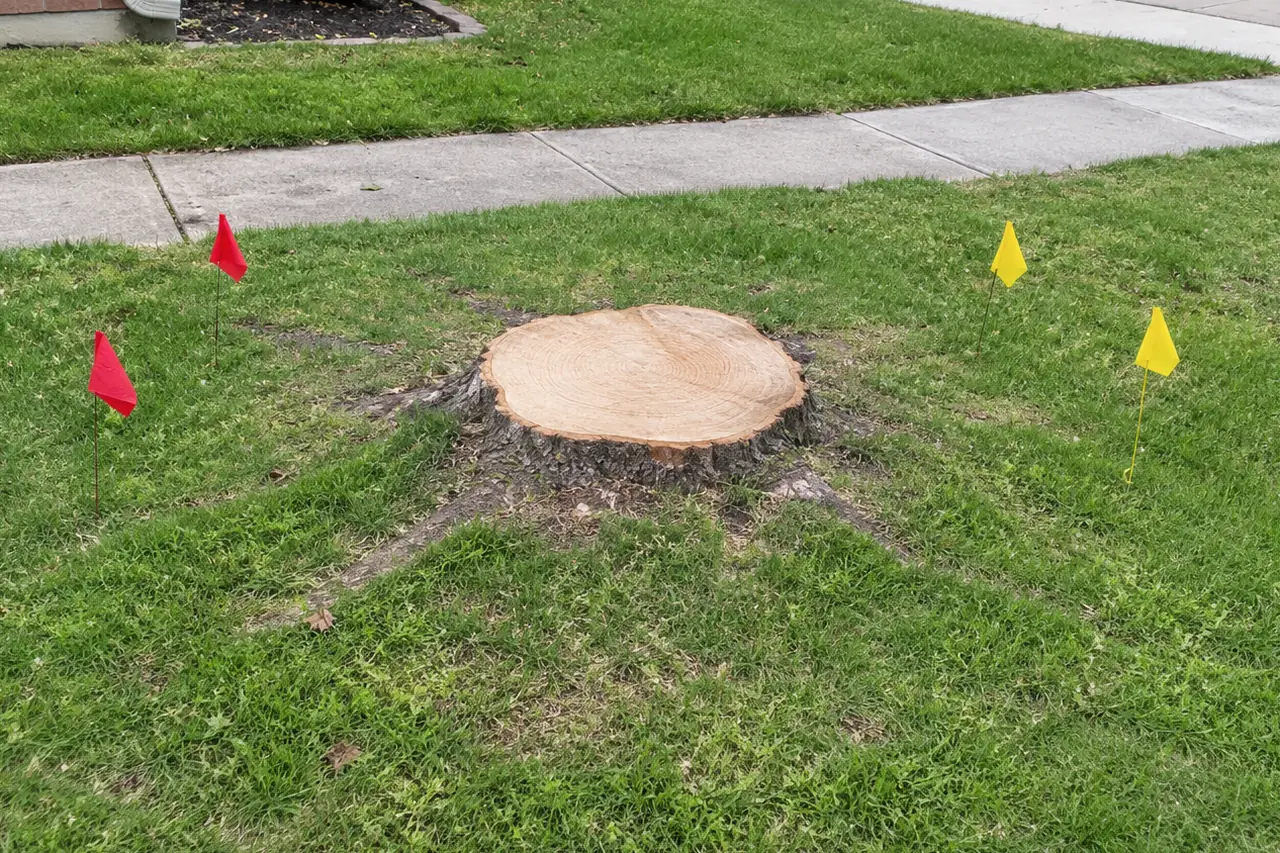
What are the little flags around the stump for?
They're how buried lines get marked once a locate request goes in: each utility on the ticket shows where its line runs, so the grinder can stay clear of it. Leave the flags and any paint alone until the grinding is finished. If a line you know is there never gets marked, or a utility doesn't respond to the ticket, Texas811 has a help article on what to do, dated Aug. 7, 2025 (checked Nov 14, 2026).
Under the state's rule at 16 TAC §18.3, the digger and the line operator can agree in writing that a locate ticket lasts longer than 14 days, and if the work isn't done when the ticket runs out, the ticket has to be refreshed for the area still to be dug (checked Nov 14, 2026). So a grind that gets rained out for a couple of weeks may need a new request.
What's left in the yard when the grinder is done?
A low spot where the stump was, filled with grindings: wood chips mixed with soil. The roots that run out past the grind stay in the ground. How much of that gets cleaned up depends on the deal. HomeGuide lists cleanup of the grindings as its own item at $2 to $4 per inch, and root removal at $75 to $150 an hour (checked Nov 14, 2026). Before you agree to a price, ask:
- How far below the grass the grind goes.
- Whether the grindings are hauled off, raked into the hole, or left in a pile for you to use.
- Whether surface roots running across the lawn are included.
- Who files the 811 request, and when.
What does grinding cost per stump and per inch?
Stumps are measured across the cut face, and the per-inch rate is where most prices start. Take a stump 20 inches across. At HomeGuide's $2 to $6 per inch, that's $40 to $120; at Angi's 2026 figure of $2 to $5 per inch, $40 to $100. But HomeGuide also lists a smallest-job charge of $80 to $160, so a single small stump often lands on that floor instead of the per-inch math (all checked Nov 14, 2026).
| What's priced | Range | From |
|---|---|---|
| Rate per inch of diameter | $2 to $6 | HomeGuide |
| Rate per inch of diameter | $2 to $5 | Angi, 2026 |
| First stump | $120 to $400 | HomeGuide |
| Grinding one stump | $150 to $500 | Angi, 2026 |
| National average for stump removal | $370 (most pay $195 to $609) | Angi, 2026, from 16,293 projects |
| Smallest job charged | $80 to $160 | HomeGuide |
| Stump grinding added to a removal | $65 to $350 | Angi tree service guide |
These are national ranges; no guide publishes Forney stump prices. The contractor's written price, after seeing the stump and the marks around it, is the one that matters. Removal prices are on the cost page.
Is it cheaper to grind several stumps at once?
Per stump, yes. Once the machine is in the yard, each added stump costs far less than the first: $30 to $60 apiece in HomeGuide's figures and $40 to $75 in Angi's 2026 figures, against $120 to $400 for the first (checked Nov 14, 2026). If an old stump has been sitting in the side yard for years, adding it to a new removal is the cheap time to deal with it.
Other stump questions from Forney homeowners
Does the City of Forney have to approve stump grinding?
The parts of Forney's tree preservation section (Sec. 39a, 2026 edition) read for this site deal with removing protected trees, not grinding stumps, and developed single-family lots are outside the section entirely under Sec. 39a.2.B.3 (checked Nov 14, 2026). The 811 notice is the rule that does apply.
What about the stump of an ash tree?
The stump stays put, but the wood shouldn't travel far. The Texas Department of Agriculture's emerald ash borer page strongly advises campers not to move firewood and to buy it locally instead. The insect had not been confirmed in Kaufman County as of the Texas A&M Forest Service's June 2026 list (checked Nov 14, 2026). See the ash tree page.
Can the stump be ground the same day the tree comes down?
Only if the locate request went in at least 48 hours ahead, not counting weekends and holidays. Ask for the request to be made when the removal is scheduled, so the marks are in by the time the trunk is down. The removal guide explains the rest of the job.
To get the stump looked at, call (469) 689-1811 or put it in the request form, and mention how many stumps there are and roughly how wide. The request goes to one independent contractor in the Forney area. For the city and county rules that sit alongside 811, see the rules page.
Sources: Tex. Utilities Code ch. 251 (§§251.002, 251.151, 251.201); 16 TAC §18.3; Texas811, when utilities aren't marked (Aug. 7, 2025); HomeGuide, stump grinding cost; Angi, stump removal cost; Angi, tree service cost; Forney Zoning Ordinance, Sec. 39a (posted Apr. 9, 2026); Texas Department of Agriculture, emerald ash borer; Texas A&M Forest Service, EAB. All checked Nov 14, 2026.